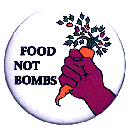
The name Food Not Bombs states our most fundamental principle: society needs to promote life, not death. Our society condones, and even promotes, violence and domination. Authority and power are derived from the threat and use of violence. This affects our everyday lives through the constant threat of violent crime, domestic violence, police repression, and the threat of total annihilation from nuclear war. Such constant exposure to violence, including the threat thereof, leads many people to hopelessness and low self-esteem.
Poverty is violence, and one expression of the violence of poverty is hunger. Millions of Americans, almost half of them children, go hungry each day. Childhood malnutrition contributes heavily to infant mortality rates, which are higher in the United States than in other industrialized nations. Globally, we continue to spend more time and resources developing, using, and threatening to use weapons of massive human and planetary destruction than on nurturing and celebrating life. By spending this money on bombs instead of food, our government perpetuates and exacerbates poverty's violence by not providing food for everyone in need. Food Not Bombs has chosen to take a stand against violence and hunger; we are committed to nonviolent social change by giving out free vegetarian food, thus celebrating and nurturing life.
Food Not Bombs is an organization devoted to developing positive personal, political, and economic alternatives. Revolutionaries are often depicted as working for the overthrow of the government by any means necessary. Food Not Bombs groups in general do not have the time or resources to attack, tear down, or overthrow the existing death culture. However, not spending our time trying to overthrow the existing power structure does not mean never struggle with it. By simply exerting our basic rights to free speech and association, we challenge the power elite and they will try to stop us from focusing on what needs to be done. We want to create new alternatives and life-affirming structures from the ground up. We want to replace the death culture with a culture of "Plumbers Not Bombs", "Day-care Not Bombs", and "Health Care Not Bombs".
Food Not Bombs responds to poverty and the lack of self-esteem in two ways. First, we provide food in an open, respectful way to whomever wants it. We will not make people jump through any bureaucratic hoops designed to control, humiliate, and often punish people who are poor. Second, we invite people who receive food to become involved in providing that food. This provides an opportunity for people to regain their power and recognize their ability to contribute and make a change.
The idea of food recovery, or food "recycling," is not new. Individuals have been "dumpster diving" to find meals for a long time; however, store owners often poison or lock dumpsters to discourage this practice. Similarly, environmentalists have long advocated composting, but this has not yet been practiced on a large scale. Therefore, it is a radical political act in today's society to recover large amounts of food in an organized and consistent manner and to feed the hungry the edible part.
Although Food Not Bombs does not have a strict political platform, there is a general political philosophy with which it has become identified over the years. The core of this philosophy is that each local group is autonomous. Every individual and group chooses its own values and politics. This chapter presents some of this philosophy from the authors' own perspective.
The New Society
Just like many people today, we are concerned about the direction in which the world is headed. Domination, violence, and killing seemed to be the predominant choices of our society. This is what we call the death culture. Acceptance of war, nuclear annihilation, environmental destruction, and genocide are widespread. It is the foundation of the power elite's "New World Order". More than ever before, the death culture is pushing the idea that it is necessary for young people to join the army and kill to have peace. Peace through the threat of war is impossible, because using the threat of destruction as a way to prevent war is nothing but domination. Few voices, however, say there is an alternative to domination and violence. Ours society places bery little value is placed on working for peace, and there is little opportunity to learn about nonviolent conflict resolution, war tax resistance, or creating a life-affirming culture.
It is not lost upon us that the major contribution to stopping bombs is our withdrawal from the economic and political structures of the death culture. As individuals, many of us engage in war-tax resistance; as an organization, we operate outside the dominate economic paradigm. We do not operate for a profit; in fact, we operate with very little money compared with the value of the food we distribute. Because we generally ignore authorities, we let them have as little contact with us as possible; but, as we want exposure for our life-affirming alternatives, we never hide what we are doing. We might protest directly in front of an oppressive bank, but the contact is on our terms.
Nonviolence in Theory
Nonviolence means responding to situations of injustice with action. The key to nonviolence is the ability to see the potential violence in a situation before it becomes violent and to act to de-escalate that potential. If we cannot stop it from happening, we can at least work to minimize the effects.
It is extremely important that we act in a manner which is consistent with our values. It is never in our interest to use violence against the police or others. On the practical side, they usually can muster significantly more violent force than we could. But, more philosophically, we don't want to use power to dominate in our efforts for social change. We want to create a society based upon human rights and human needs; not the threat and use of violence. We do not want to dominate; we want to seek the truth and to support each other as we resolve conflicts without violence.
Even the food we chose to serve is an expression of our commitment to nonviolence. We try to avoid using any animal products, because we see the damage it does not only to the animal but to ourselves, the environment, and the economy. Mainstream food production is an inherently violent process, involving the slaughter of millions of animals and the poisoning of our air, water, soil, and bodies with chemical fertilizers and pesticides. The meat and dairy industries control government policies that primarily serve their own financial interests and not those of the public.
Nonviolence in Practice
As an organization, we strive to be very inclusive. There is room for all progressive political perspectives and for everyone to express themselves. For some, the decision to work for food, not bombs, is a total change in lifestyle. For others, the decision is expressed through a commitment to life affirming values while continuing to work at a job for pay in mainstream society. We try to value individuals for the contribution they offer, without any expectation that they be completely divorced from the status quo.
Our world is multicultural, and social and political structures need to be sensitive to this reality. Challenging racism, classism, gender bias, homophobia, and other oppressive behaviors is essential to creating a life-affirming, self-sustaining world. Everyone needs to be engaged in multicultural work, and this includes the members of Food Not Bombs as well as those with whom we come in contact, both on the street and within the other service and political organizations with which we work.
One of the unique ways in which Food Not Bombs engages in multicultural work is the creation of ways to share access to resources. Members identify and obtain food the wider community needs. We provide an example of how a small group of people with limited economic resources can make a big difference in the quality of life for many people by organizing and recovering a waste product of the existing society. It is our hope that the redistribution of resources other than food becomes an activity that is taken on by an increasingly larger number of people. After all, we are the people we are trying to serve.
Food Not Bombs groups are open and democratic. Decisions are made using a process called "consensus." Consensus creates an environment in which different opinions can be expressed without fear, and where conflicts can be resolved in a respectful, nonviolent manner. It is not a competition of ideas to see which one wins the favor of the group. Rather, it is working cooperatively to synthesize all ideas into the best possible decision for everyone involved. The consensus process strives to assure that everyone has an opportunity to share their point of view and to participate in decision making. Consensus does not mean that everyone thinks the same way; people can agree to disagree and still reach consensus.
People become empowered when encouraged to participate and take more
responsibility for the decisions and actions of the group. This teaches
them not only how to be powerful nonviolently, but also how to seek
access to power. We will never live in a society with equal power
shared by all people. However, it is possible to imagine a world in
which everyone has equal access to power, and along those lines,
consensus is a process based upon the opportunity for all to participate
in decision-making. The particular model your group chooses to use is
will be determined by your size and needs. On Conflict and Consensus
(see bibliography) describes a model of consensus called "Formal
Consensus." This would be a good place to start in creating your own
process.
Start a Food Not Bombs
group in you community today!
A FOOD NOT BOMBS handbook
[ More FNB
Websites | Flyers You Can
Reprint | Food Not Bombs
Handbook |
How to
Start a Food Not Bombs ]
[ Events | Home ]