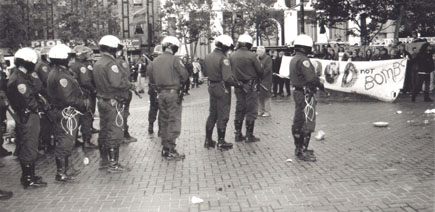
Many Americans have little or no idea of how much
their country is controlled by a web of covert intelligence operations.
Every week or two Americans hear something about torture and spying in
media. Most reports center around the war on terror. We hear warnings of
dangerous Islamic plots seeking to execute the next World Trade Center
type attack on our democracy. With 9/11 as the pretext, the government
can spy on just about anyone under the guise of possible terrorist
activity. The examples can be seen in the revelations of the National
Security Agency's (NSA) warrantless wiretapping of thousands of
innocent Americans or Obama s new Years Eve signing of the National
Defense Authorization Act of 2012. While most of Americans assumed
these methods are used to only monitor terrorists, the evidence shows
that the Federal government has been collecting phone call and e-mail
records of millions of Americans, infiltrating community groups and
disrupting the efforts of law abiding Americans. The idea that the
government was capable or even willing to do these types of activities
seemed farfetched before 9/11. The unfortunate reality is that although
9/11 gave authorities the excuse to be somewhat open about and step up
their spying, the surveillance and disruption began well before the
tragedies of that day. Anyone seeking to change America for the better
that might also be considered a challenge to corporate power must understand
that they will be confronted by an invisible force. Don't let this
discourage or frighten you. Experience shows it is possible to effect
change even facing these very real and powerful obstacles.
The use of covert operations implemented by government and corporate
intelligence organizations is a major obstacle to the formation of a
real democracy. Well funded and carefully planned campaigns are waged
against almost every citizen effort to make our communities better from
attempts to protect the environment, seek financial and electoral
reform, to projects wanting to improve local transportation, food
security, education or access to healthcare. Government and corporate
intelligence organizations monitor the public to see if there is any
community opposition or threats to corporate power.
Any time a powerful corporate institution believes that its profits and
influence could be diminished it will take all necessary measures to
maintain their position. They have a well financed and organized system
to suppress these threats. Corporate think tanks, academic departments
and military research units review past strategies, develop new methods
and techniques, study their opposition and implement there plans to
defend their interests with a precision based on decades, even
centuries of experience. In 2005 I identified over 55 military, federal,
state and local government agencies that could be responsible for
monitoring and disrupting Food Not Bombs in Arizona when I helped the
ACLU file a FOIA request for documents. We did not have the legal right
to seek information from Raytheon Missile Systems, Chevron, The United Way, KB
Homes or the many other corporate institutions that we believe were
actively working to disrupt Food Not Bombs in Arizona. I am sure we
missed many other intelligence organizations so secret we had no idea
they were investigating and sabotaging our work. The U.S. government announced its
intelligence budget for the first time in the fall of 2010 reporting that the American taxpayers
spent $80 billion during that fiscal year. This included both domestic spying and some military intelligence.
This figure did not include the black budget raised through the sale of drugs, guns and the many other ways
available to raise money covertly. This also did not include the billions spent by corporations on their own intelligence programs.
When an community organization starts to have an impact its members are profiled and relationships studied.
A team is assembled that may include experts from many disciplines including phycology, social media, anthropology and culture, systems and patterns management,
surveillance and technology professionals, and people responsible for public relations and psychological warfare.
They may have a unit that organizes whispering campaigns smearing the key members of your group to a targeted list of local political and business leaders and potential allies. They may organize a phony organization that appears to share your goals. They can send several levels of informants to your meetings and events from confidential informants working for a small fee or in exchange for their freedom or improved conditions for an incarcerated relative. They might also have full time employees with local, state or federal law enforcement join your organization.
Of course your phone, email, web visits will be recorded and your
bank account, motor vehicle records and any other personal data can and will be collected and analyzed. Most of the time this will all be happening in the background. Sometimes there will be an increase in intensity and at times the amount of attention may be very limited depending on the perceived threat. You may notice you are being followed or photographed and many times it will not be obvious.
I have lived under very intense government and corporate scrutiny for much of the past 30 years.
When you are first aware that you have been the target of an intelligence operation it can be unsettling.
Over time you will become accustom to the attention and develop a philosophy.
Since you can not hide or have any secrets you will find that you must always seek to be as honest as possible
and only take actions you can be proud of. While you may believe you know who the informants
are it is best not to make any public accusations to their employment but be prepared to limit their
destructive behavior. Any suggestions of violence should be loudly objected to while suggesting they are
involved with the wrong organization. The most important thing is to continue with our work.
If they frighten you into quitting they have succeeded. The struggle to bring democracy,
a safe environment and a sustainable future is so important we must stay focused on our good works.
We also need to figure out how to remove the threat of covert activity to disrupt our ability to build a
positive society.
Please consider reading the rest of this article and feel free to visit the links to develop a more complete
understanding of the details described. I focus on the 30 year campaign against Food Not Bombs since
I have direct experience with this history. This expensive decades long campaign offers some
insight into the reality of the war on terror. If Food Not Bombs is one of the most hard core terrorist groups in the United States then maybe the war on terror is nothing more then an excuse to silence
protest.
In our effort to make a better world we must seek to end all funding and support for every aspect of
covert domestic intelligence operations. We need to expose their complex processes of disruption to the public.
The people organizing and directing these anti-democratic programs should be
prosecuted as criminals not financed through our tax dollars. We will
have a difficult time removing money from politics, implementing policies that protect our environment,
properly fund education, healthcare and other social services and end war if we do not figure out
a way to shut down the intelligence community.
Keith McHenry
January 21, 2012
Taos, New Mexico
False Allegations of
Terrorism
Food Not Bombs
volunteers tortured
PAGE 2